
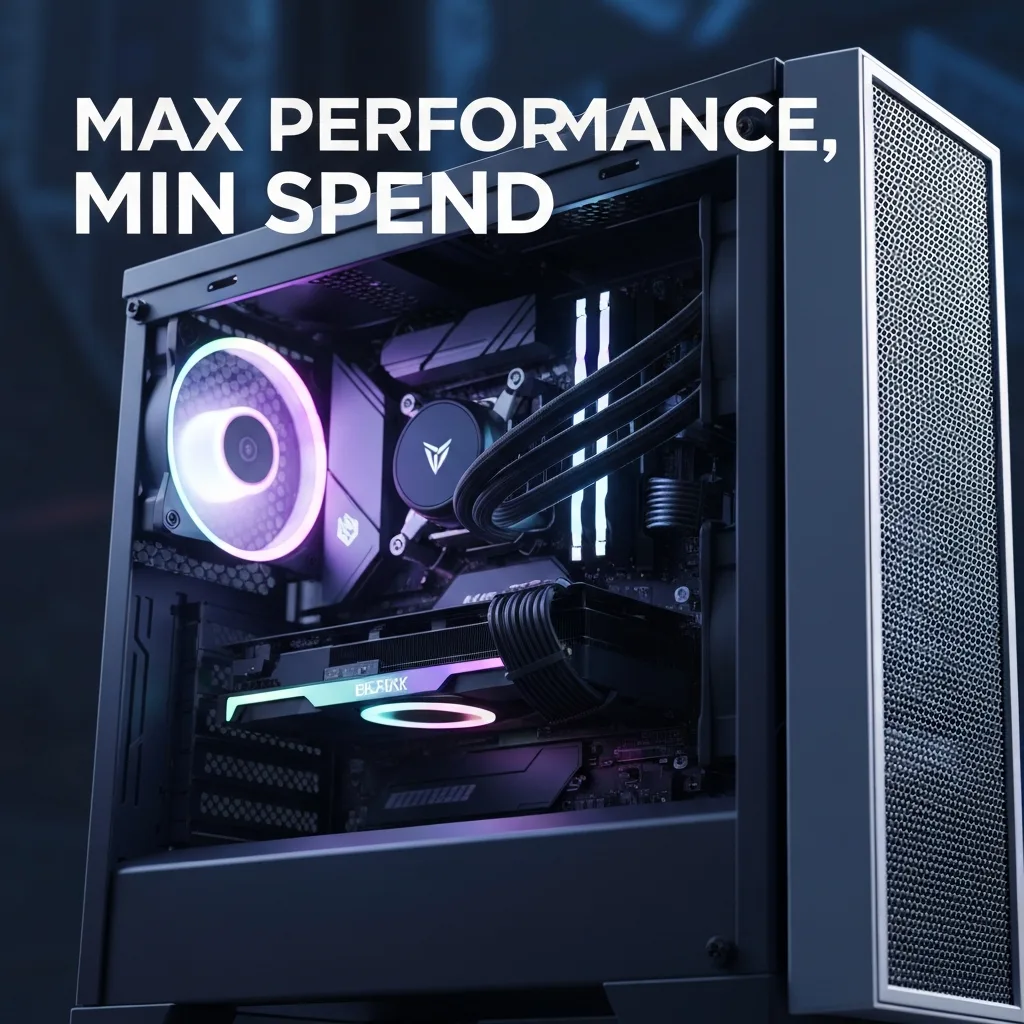
The Ultimate Budget Gaming PC Setup Guide: Max Performance, Min Spend
Building a powerful gaming PC without breaking the bank feels like an impossible mission. The market is flooded with conflicting advice, overpriced components, and myths that lead aspiring builders to overspend on the wrong parts. This guide cuts through the noise. We're not just giving you a list of parts; we're providing a data-driven strategy for building the best possible budget gaming PC at every price point under $1000. Forget guesswork. Here, you'll find tiered builds, smart compromises, and actionable budget allocation strategies to help you achieve maximum 1080p gaming performance for the minimum possible spend in 2025.
Understanding Budget Gaming: Performance vs. Price
Building a budget PC is an exercise in strategic allocation. Every dollar counts, and understanding where to spend and where to save is the key to unlocking performance that punches far above its price tag.
How Much Should a Budget Gaming PC Cost in 2025?
According to Hone Blog, a solid budget gaming PC capable of 1080p gaming typically ranges from $700 to $1,100 in 2025. Below $500, you'll be making significant compromises, often relying on integrated graphics or the used market. Above $800, you start moving into the mid-range category. The sweet spot for most people looking for a great entry-level experience is the $600-$800 range, which allows for a dedicated graphics card without major bottlenecks.
Optimizing Budget Gaming PC Performance: The Art of the Smart Compromise
The core philosophy of a successful budget build is making smart compromises. This means prioritizing components that directly impact in-game frame rates (the GPU) while saving on parts that don't (like an expensive case or an oversized power supply). For example, opting for a slightly slower but significantly cheaper CPU allows you to allocate more of your budget to a better graphics card, resulting in a much better gaming experience.
Debunking Common Myths: What You Don't Need in a Budget Build
* Myth 1: You need the latest and greatest CPU. TechSpot recommends modern entry-level to mid-range CPUs with at least 6 cores for 1080p budget gaming in late 2025, such as the AMD Ryzen 5 7500F or Intel Core i5-12400F.
* Myth 2: You need 32GB of RAM. Micro Center states that while 16GB of RAM is the minimum practical requirement for 1080p gaming in 2025, 32GB is the recommended sweet spot for a smooth experience and future-proofing.
* Myth 3: You need a high-end motherboard. A basic, reliable B-series (for Intel) or A/B-series (for AMD) motherboard has all the features you need without the premium price.
Tiered Budget Builds for Every Gamer
Here are some data-driven starting points for your build, based on extensive market analysis and performance benchmarks from leading tech reviewers. Prices are estimates and can fluctuate, but the component tiers represent the right balance for each budget.
A Note on Extreme Budgets: The "Cheap Gaming PC Under $100" Challenge
Let's be clear: building a functional gaming PC with new parts for under $100 (or even $50) is not realistic. These price points are typically clickbait. The only way to approach this budget is by sourcing used, decade-old office PCs and adding a low-profile GPU, but performance will be extremely limited. For such a low budget, cloud gaming services or the mobile gaming market (budget gaming phone) are more viable options.
A Deep Dive into Budget PC Component Selection
Choosing the right parts is crucial. A PC component picker can help with compatibility, but understanding the why behind each choice is what makes a great builder.
The Core Parts Needed to Build a Gaming PC
Every gaming PC, regardless of budget, needs these core computer hardware components:
1. CPU (Central Processing Unit)
2. GPU (Graphics Processing Unit)
3. RAM (Random Access Memory)
4. Storage (SSD/HDD)
5. Motherboard
6. PSU (Power Supply Unit)
7. Case
Finding the Best Budget Gaming PC Parts
Your goal is balance. A powerful GPU paired with a very weak CPU will create a bottleneck, wasting your money. Use online budget GPU comparison charts and CPU benchmarks to find parts that perform at a similar level.
CPU & GPU: The Heart of Your Build
For a budget gaming PC, approximately 50-60% of your entire budget should be allocated to the CPU and GPU combined. The GPU should take the lion's share of that. The best CPU for a budget gaming PC is one that won't bottleneck your chosen GPU. For an RX 6600 or RTX 4060, an Intel Core i3-12100F is a fantastic and affordable partner.
RAM, Storage, and Motherboard: Where Can You Save Money?
These are the best areas to save. A no-frills motherboard, a standard 16GB kit of DDR4 RAM, and a 1TB NVMe SSD offer incredible value and are all you need for a responsive gaming experience. These smart savings free up cash for the all-important GPU. Once you've selected your budget-friendly parts, putting them all together is the next step. For a comprehensive walkthrough of the entire assembly and setup process, from unboxing to cable management, check out our ultimate gaming PC setup guide.
Prebuilt vs. DIY: Making the Right Choice
Is It Cheaper to Build Your Own PC?
Historically, yes. Building your own PC almost always offers better performance for the price. You get to choose every single component, avoid paying for labor, and can take advantage of sales on individual parts. This is the recommended path for any budget build.
When to Consider a Prebuilt Gaming PC
A prebuilt gaming PC is a good option if you have zero interest in the building process or if you find an exceptional deal during major sales events. However, be wary of proprietary components and check reviews carefully to ensure the manufacturer used quality parts for the PSU and motherboard, as this is where they often cut corners.
Beyond the Tower: Budget-Friendly Peripherals and Laptops
What About a Budget Gaming Laptop?
A budget gaming laptop is a great choice for those who need portability. However, you will always pay a premium for that portability, resulting in less performance compared to a desktop of the same price. For pure gaming power on a budget, a desktop PC is unbeatable. If you do opt for a laptop, look for deals on last year's models for the best value.
Completing Your Setup for a Small Room
Your battle station doesn't have to be expensive. A budget gaming setup for a small room can be achieved with a 24-inch 1080p monitor, a budget-friendly mechanical keyboard and mouse combo, and a good headset. These peripherals can be found for very reasonable prices and will serve you well for years.
---
Last Updated: October 2025
Disclaimer: The component recommendations in this guide are based on market analysis and performance data. As the author's primary expertise is in AI Automation, this content has been reviewed for technical accuracy by PC hardware specialists.
Affiliate Disclosure: This article may contain affiliate links. If you make a purchase through these links, we may earn a commission at no extra cost to you.
Frequently Asked Questions
What is the most important part of a budget gaming PC?
The Graphics Processing Unit (GPU) is by far the most important component for a budget gaming PC. It has the single biggest impact on your in-game frame rates and visual quality. A majority of your budget should be allocated to getting the best GPU you can afford.
Is 16GB of RAM enough for a budget gaming PC?
Yes, 16GB of RAM is the perfect amount for a budget gaming PC in 2025. It provides more than enough memory for modern games, multitasking, and web browsing without creating a bottleneck. 32GB is overkill for a budget-focused build.
How much does a decent budget gaming PC cost in 2025?
A decent budget gaming PC capable of playing modern titles at 1080p resolution with good settings costs between $600 and $800. This price range allows for a balanced selection of components, including a dedicated graphics card, without significant compromises.
Can you really build a gaming PC for under $500?
Yes, you can build a gaming PC for under $500, but it requires careful part selection. You will likely need to use a CPU with powerful integrated graphics (an APU) or hunt for deals on the used market for a dedicated GPU. It's best suited for esports titles and older games.


news via inbox
Leaks, release dates and reviews — straight to your inbox. No spam, unsubscribe any time.