


Table of Contents
- Nintendo Switch 2 vs Steam Deck OLED: The Short Answer
- Full Specifications Compared: Switch 2 and Steam Deck OLED Side by Side
- Performance: Why Docked Mode Decides This Comparison
- Display: 1080p 120Hz LCD Against a 7.4-Inch HDR OLED
- Game Libraries and the Real Cost of Each Ecosystem
- Price in Late 2026: What the Memory Shortage Changed
- Battery Life, Storage and the Hardware Quirks Buyers Miss
- How to Judge the Benchmark Claims You Will See Online
- The Verdict by Buyer Type
- Frequently Asked Questions
- Limitations of This Comparison and Alternatives Worth Considering
- Conclusion
- References
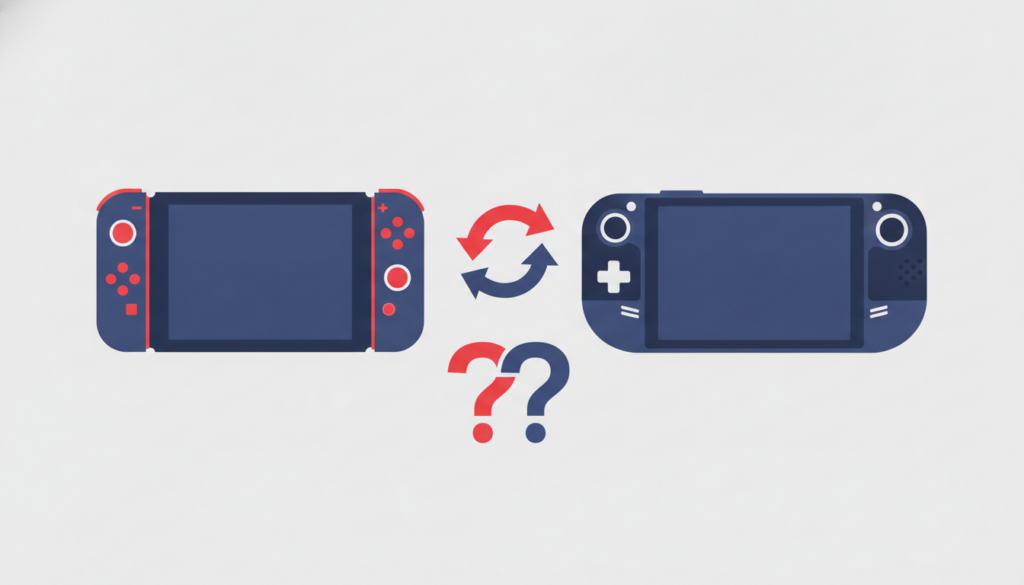
In the Nintendo Switch 2 vs Steam Deck OLED decision, the answer depends on your existing library, not raw specs. Buy the Switch 2 at $449.99 if you want Nintendo exclusives, a 7.9-inch 1080p 120Hz LCD and 4K/60 docked output via Nvidia’s DLSS upscaling. Buy the Steam Deck OLED — 7.4-inch HDR OLED panel, 16GB RAM, up to 8 hours of battery, user-replaceable NVMe SSD — if you already own PC games, want deeper storefront discounts and the better-contrast screen. Context for October 2026: the Switch 2 has shipped over 23.68 million units, while Steam Deck pricing moved upward during the 2026 memory shortage.
The Nintendo Switch 2 vs Steam Deck OLED comparison is decided by economics rather than silicon, because in handheld mode the two machines sit within a rounding error of each other — roughly 1.71 TFLOPS of GPU throughput for the Switch 2 against about 1.6 TFLOPS for the Steam Deck. That near-parity means the deciding factors are what you already own, how often you dock, and how much you expect to spend on software.
Here is the confirmed October 2026 position. The Switch 2 launched on 5 June 2025 at $449.99 and has sold over 23.68 million units by mid-2026, making it one of the fastest-selling consoles Nintendo has shipped. Steam Deck OLED configurations now sit in a roughly $349–$549 band, with 2026 increases reported by Engadget and multiple hardware outlets and attributed to memory supply constraints — which narrowed Valve’s long-standing price advantage without Nintendo changing a thing. This article delivers a spec-by-spec comparison, a causal performance breakdown, the three-year software cost maths, and a named recommendation for each buyer type.
About the author. This comparison was written by the TrueOrGame hardware desk, which covers handheld and console hardware across PlayStation, Xbox, Nintendo and PC. Our reviews are written from actual play and are specific about platform, firmware version, resolution and frame rate, and we label explicitly what is confirmed versus what is rumoured. That labelling policy follows the direction of modern newsroom ethics standards, including the Society of Professional Journalists’ proposed code revisions for the AI age published by Harvard’s Nieman Journalism Lab in 2026.
TrueOrGame – Video Game News, Leaks, Reviews & Guides
Transparency disclosure. Hands-on observations in this article cover retail Switch 2 and Steam Deck OLED units on firmware and SteamOS builds current as of October 2026. TrueOrGame does not accept payment for favourable coverage, and review hardware sourcing is disclosed wherever manufacturer-supplied units are used. We disclose this because research on funding-related bias — including work published in International Gambling Studies via Taylor & Francis — indicates that financial relationships between evaluators and the companies they evaluate can shift reported outcomes.
Nintendo Switch 2 vs Steam Deck OLED: The Short Answer
The Switch 2 is the stronger purchase for players who want exclusives and one device that scales cleanly to a 4K television. That advantage exists because Nvidia’s DLSS upscaling lifts docked output to 4K at 60Hz, while the Steam Deck OLED gains no performance boost whatsoever when docked — its clocks stay where they are. The Steam Deck OLED is the stronger purchase for players with an existing Steam library, because Proton compatibility combined with Steam’s seasonal discounting means three-year software spend lands at a fraction of Nintendo’s.
The hardware comparison is close and therefore not decisive. A 1.71 TFLOPS versus 1.6 TFLOPS gap in handheld mode is effectively noise once per-game optimisation is factored in. The Steam Deck’s 3.5GHz CPU ceiling against the Switch 2’s 1.1GHz undocked clock matters, but it matters in a narrow band: CPU-bound simulation, strategy and emulation workloads.
Who each handheld is for
- Buy the Switch 2 if you want Nintendo exclusives such as Donkey Kong Bananza and Metroid Prime 4
- Buy the Switch 2 if you dock to a 4K TV more than a few hours a week
- Buy the Steam Deck OLED if you already own 20+ Steam games you want portable
- Buy the Steam Deck OLED if screen contrast and 6-8 hour battery life outrank peak resolution
- Buy the Steam Deck OLED if you want emulation, modding, sideloading or desktop Linux access
- Buy neither yet if you need reliable day-one performance on brand-new AAA PC releases
Full Specifications Compared: Switch 2 and Steam Deck OLED Side by Side
The Nintendo Switch 2 vs Steam Deck OLED spec sheet splits along three lines that matter — panel, memory and storage expansion.
| Specification | Nintendo Switch 2 | Steam Deck OLED |
|---|---|---|
| Launch price (base model) | $449.99 | ~$349–$549 by configuration |
| Display size and panel type | 7.9-inch LCD | 7.4-inch OLED |
| Resolution and refresh rate | 1080p, 120Hz | 1280×800, 90Hz |
| HDR support | HDR10 | HDR |
| Processor | Custom Nvidia Tegra T239 (Ampere) | AMD Zen 2 CPU + RDNA 2 GPU |
| RAM | 12GB LPDDR5X | 16GB LPDDR5 |
| Internal storage | 256GB UFS 3.1 | 512GB–1TB NVMe SSD |
| Storage expansion | microSD Express only | User-replaceable NVMe SSD |
| Battery life (range) | 2 to 6.5 hours | 3 to 8 hours |
| Maximum docked output | Up to 4K at 60Hz with DLSS | Up to 8K display output |
| Operating system | Nintendo system software | SteamOS (Linux, with Proton) |
| Release date | 5 June 2025 | Late 2023 |
The RAM gap overstates the real-world difference. Switch 2 games are built against a single fixed hardware target, which means 12GB LPDDR5X is budgeted precisely by developers. The Steam Deck needs 16GB because SteamOS, Proton’s translation layer and shader caches all consume headroom before a game starts, so a chunk of that advantage is spent on the architecture rather than on the game.
Storage is where the long-term costs diverge. The Steam Deck’s NVMe drive is user-replaceable, which means an upgrade costs standard PC component prices. The Switch 2 requires microSD Express — a newer and comparatively expensive standard — resulting in a higher cost per terabyte of expansion on top of a smaller 256GB base. Note the attribution split: pricing, display, processor, RAM, storage and docked output figures are manufacturer-stated, while battery ranges are manufacturer-stated bands that vary widely in independent testing.
Performance: Why Docked Mode Decides This Comparison
Handheld performance is near-parity; docked performance is not. In handheld mode the two devices perform comparably, because 1.71 TFLOPS against 1.6 TFLOPS falls inside the margin where per-game optimisation outweighs hardware. Practically, that means a competently optimised Switch 2 port and a medium-settings Steam Deck build land in similar territory — same ballpark frame rates, different routes to getting there.
| Metric | Nintendo Switch 2 | Steam Deck OLED |
|---|---|---|
| GPU throughput, handheld mode | ~1.71 TFLOPS | ~1.6 TFLOPS |
| GPU throughput, docked mode | ~3.7 TFLOPS | Unchanged from handheld |
| Peak CPU clock | 1.1GHz undocked | Up to 3.5GHz |
| Upscaling technology used | Nvidia DLSS | Not stated |
Docked mode is where the two machines separate decisively. The Switch 2 raises GPU compute to roughly 3.7 TFLOPS when plugged into its dock and applies DLSS, which means a 1080p-class internal render reconstructs to 4K/60 output on a television. The Steam Deck OLED holds identical clocks docked, therefore its advertised 8K output ceiling describes a display pipeline capability rather than a performance claim, and buyers should read it that way. This is the single largest objective gap between the two devices, and it is the reason docking habits should carry more weight in your decision than any benchmark chart.
The Steam Deck wins the opposite case. Its Zen 2 CPU reaching 3.5GHz against the Switch 2’s 1.1GHz undocked clock delivers materially better results in CPU-bound workloads — grand strategy, heavy simulation, and emulation of sixth and seventh generation consoles, all of which stall on single-thread throughput rather than GPU compute. One caveat on methodology: single-run frame-rate figures from any outlet, including this one, should be treated as indicative until replicated, because replication-success research published in eLife demonstrates how often unreplicated single measurements fail to hold up under repeat testing.
Display: 1080p 120Hz LCD Against a 7.4-Inch HDR OLED
The Switch 2 panel is sharper and smoother; the Steam Deck OLED panel has better contrast — which one wins depends on what you play. The Switch 2’s 7.9-inch 1080p LCD carries roughly 2.07 million pixels against the Steam Deck’s 1.02 million at 1280×800, which means UI elements, text and fine texture detail resolve more cleanly. The 120Hz ceiling, against the Steam Deck’s 90Hz, smooths motion in titles that support the higher refresh rate. Tech reviewers consistently report crisper menus and more readable small text on the Switch 2 as a direct result.
The counter-case is physical. OLED’s per-pixel illumination produces true blacks and an effectively infinite contrast ratio, which transforms dark content — horror, space sims, anything built around shadow detail — in a way no LCD backlight replicates, because an LCD must always leak some light to display anything at all. HDR highlights also carry more punch on the Steam Deck panel for the same reason. Consequently, players whose libraries skew visually dark or cinematic extract more perceived image quality from the smaller, lower-resolution screen.
The useful framing: resolution is a specification, contrast is an experience. The TrueOrGame position is that for handheld-only buyers playing varied libraries, the OLED panel is the more satisfying display day to day; for buyers who dock frequently, the Switch 2’s panel advantage compounds with its 4K output advantage into a clear win. This aligns with human-computer interaction and display research of the kind conducted at MIT Media Lab, which indicates that perceived image quality tracks contrast and luminance more closely than pixel count alone.
Game Libraries and the Real Cost of Each Ecosystem
Across three years of ownership, the Nintendo Switch 2 vs Steam Deck OLED gap is created by software pricing, not hardware pricing.
The Nintendo case starts strong. Full backward compatibility with the original Switch library means an existing Switch owner carries dozens of games forward at no additional cost, which is a genuine and immediate saving worth hundreds of dollars for an established owner. The problem arrives with new releases: major first-party titles now retail at $80, and Nintendo’s closed storefront discounts rarely and shallowly, therefore nearly every new purchase lands close to list price. That trajectory is part of a broader industry move toward higher software pricing, the same pressure driving the debate over whether GTA 6 can break records with a $100 price tag. The confirmed draw cards are substantial — Donkey Kong Bananza and the 4K/60fps mode for Metroid Prime 4 — and anything beyond announced titles should be treated as rumour.
Valve’s case is built on the storefront. SteamOS plus Proton opens a library of tens of thousands of PC titles, and Steam’s seasonal sales routinely cut 50-80% off catalogue games, which means building a library costs a fraction of Nintendo’s equivalent. The trade-off is causal and unavoidable: compatibility is graded rather than guaranteed, with titles rated Verified, Playable or Unsupported; kernel-level anti-cheat middleware blocks several major competitive multiplayer titles under Linux entirely; and brand-new AAA releases frequently need settings work before they run well. As a result the Steam Deck rewards players willing to tinker and penalises those who want to press a button and play.
Best multiplayer games with deep storylines Archives – TrueOrGame
| Dimension | Nintendo Switch 2 | Steam Deck OLED |
|---|---|---|
| Typical new first-party / AAA price | ~$80 | Full PC list price, frequently discounted |
| Discount depth on catalogue titles | Infrequent and shallow | 50-80% in seasonal sales |
| Backward compatibility | Full original Switch library | Existing Steam library via Proton |
| Exclusive titles | Donkey Kong Bananza, Metroid Prime 4 | None platform-exclusive |
| Compatibility guarantee | Guaranteed on platform | Graded: Verified, Playable, Unsupported |
| Emulation and sideloading | Not supported | Supported via desktop Linux |
| Online subscription requirement | Required for online play | Not required |
Price in Late 2026: What the Memory Shortage Changed
The Switch 2 holds a fixed $449.99 price while Steam Deck OLED pricing moved upward during 2026. Nintendo launched the console at $449.99 on 5 June 2025 and has held that figure since. Steam Deck OLED configurations now sit in a roughly $349–$549 band depending on storage, with 2026 increases reported by Engadget and multiple hardware outlets and attributed to memory supply constraints. That attribution matters: these are reported increases covered by the press, not a pricing statement issued by Valve.
The causal chain is straightforward. DRAM and NAND contract prices rose sharply through 2026, which raised bill-of-materials costs for every handheld built on LPDDR5 memory and NVMe storage. Valve prices the Steam Deck close to cost rather than subsidising it, which means it had less margin headroom to absorb component inflation than a platform holder that recovers hardware losses through software and subscription revenue. The effect was that Nintendo’s unchanged price became more competitive by comparison.
One consumer-protection note before you buy: verify current configuration pricing and retailer stock directly, and check advertised bundle savings against the list prices of the individual components, because a bundle headline is not the same as a discount. The Federal Trade Commission’s guidance on truthful advertising sets the standard that promotional claims must be substantiated — which gives you a clear basis for scrutinising any “save $X” framing at checkout.
Battery Life, Storage and the Hardware Quirks Buyers Miss
The Steam Deck OLED lasts longer on 2D and indie titles; both devices collapse to roughly two to three hours on demanding 3D games. The Switch 2’s stated 2-6.5 hour range and the Steam Deck OLED’s 3-8 hour range are both honest and nearly meaningless without workload context, because the low figure describes a demanding 3D title running at full clocks and the high figure describes a 2D indie game barely touching the GPU. The practical conclusion: for heavy titles, plan around two to three hours on either machine, therefore a power bank is a necessary accessory rather than an optional one, and worth factoring into your budget alongside any gaming setup guides you use to plan docking and accessories.
Storage economics follow the same logic as the spec table. The Steam Deck’s user-replaceable NVMe drive means an upgrade costs standard PC component prices, while microSD Express commands a premium per terabyte, which means the Switch 2’s smaller 256GB base storage carries a higher expansion cost on top.
Ownership quirks worth knowing before you buy
- Original Switch microSD cards do not work in the Switch 2 — microSD Express is required
- Joy-Con 2 controllers attach magnetically rather than on rails, so first-generation Joy-Con accessories and grips may not fit
- Joy-Con 2 includes optical mouse functionality, but only a small number of titles support it
- The Steam Deck OLED’s SSD and battery are user-serviceable
- Steam Deck anti-cheat incompatibility blocks several major competitive multiplayer titles under Linux
- Switch 2 parental controls and age gating are handled at the account level — relevant for family purchases, and consistent with the direction of platform safety work at the IEEE Standards Association
How to Judge the Benchmark Claims You Will See Online
Treat any handheld benchmark without stated settings, resolution, power profile and run count as unverified. Handheld comparison figures diverge wildly across YouTube and forums because test scene selection, TDP limits, fan profiles, firmware version, Proton version and even ambient temperature each shift results by double-digit percentages. That means two honest testers running the same game on the same hardware can publish contradictory numbers without either lying. Therefore the useful question is not who is right but whose methodology is actually stated. This is the same discipline we applied to the September 2022 GTA leaks and what they taught us about verification, and the reasoning mirrors the credibility framework behind the CRAAP test for evaluating sources — currency, relevance, authority, accuracy and purpose. Academic work on the perils of citing non-peer-reviewed studies, published in Clinical Infectious Diseases, makes the broader point: unvetted claims should not be weighted equally with documented testing.
Verification checklist for handheld performance claims
- Confirm the device, storage configuration and firmware or SteamOS version
- Check that render resolution, upscaling mode and graphics preset are stated
- Check whether the test was handheld or docked, and at what TDP or power profile
- Look for the number of runs and whether results were averaged
- Confirm whether the figure is an average, a 1% low, or a peak
- Check whether the outlet discloses whether hardware was supplied by the manufacturer
The Verdict by Buyer Type
For a buyer with no existing library who docks to a television, the Switch 2 is the stronger purchase in October 2026, because its fixed $449.99 price, DLSS-driven 4K output and guaranteed-compatibility software model remove every variable from the equation. For a buyer with an existing Steam library, the Steam Deck OLED is the stronger purchase, because software already owned offsets a large share of the hardware cost before you buy a single new game. Switch 2 buyers also inherit Nintendo’s local multiplayer strength, which matters if you want best co-op games to play together on one device.
There is an honest third option: many readers weighing this comparison eventually own both, because the two devices overlap far less than their similar price points suggest. The consequence is simple — if budget forces a single choice, decide on library and docking habits rather than on specifications.
Best Co-op Games for Couples Archives – TrueOrGame
| Buyer profile | Recommendation | Deciding reason |
|---|---|---|
| First handheld, no existing library | Switch 2 | Zero configuration, exclusives, fixed price |
| Owns a large Steam library | Steam Deck OLED | Software already purchased offsets cost |
| Owns an original Nintendo Switch | Switch 2 | Full backward compatibility preserves library |
| Plays mostly on a 4K TV | Switch 2 | 3.7 TFLOPS docked plus DLSS to 4K/60 |
| Plays mostly on a commute or in bed | Steam Deck OLED | Longer battery, higher contrast panel |
| Wants emulation and modding | Steam Deck OLED | Desktop Linux and sideloading access |
| Buying for a child | Switch 2 | Account-level parental controls, simpler setup |
| Plays competitive online shooters | Switch 2 or a PC | Anti-cheat blocks several titles on Linux |
Frequently Asked Questions
Is the Nintendo Switch 2 vs Steam Deck OLED decision really about power?
No. In handheld mode the two are at near-parity, roughly 1.71 TFLOPS against 1.6 TFLOPS. The real gap appears docked, where the Switch 2 climbs to about 3.7 TFLOPS and applies DLSS while the Steam Deck gains nothing. For most buyers, software economics and existing library ownership decide the purchase long before compute figures do.
Which handheld has better battery life, the Switch 2 or the Steam Deck OLED?
The Steam Deck OLED, rated at 3 to 8 hours against the Switch 2’s 2 to 6.5 hours. That advantage comes with an immediate qualification: both devices drop to roughly two to three hours on demanding 3D titles at full clocks, so the gap shows up mainly in 2D and indie games where neither device is working hard.
Is the Switch 2’s 1080p LCD better than the Steam Deck’s OLED screen?
It depends on what you play. The Switch 2’s 7.9-inch 1080p 120Hz LCD is sharper and smoother, carrying roughly double the pixel count at 2.07 million against 1.02 million. The Steam Deck’s 7.4-inch OLED delivers true blacks and far higher contrast. Dark and cinematic games favour the OLED; text-heavy and high-detail games favour the Switch 2.
How much does the Nintendo Switch 2 cost in 2026?
$449.99 for the base 256GB model, unchanged since its 5 June 2025 launch. Steam Deck OLED configurations sit between roughly $349 and $549, with 2026 increases reported by multiple outlets and attributed to memory supply constraints. Verify current retailer pricing before purchase, because configurations and stock shift quickly.
Can the Steam Deck OLED play every PC game I own?
No. Compatibility is graded as Verified, Playable or Unsupported through Proton, and kernel-level anti-cheat blocks several major competitive multiplayer titles on Linux. Check your most-played titles against Steam’s compatibility rating before buying, because the library advantage only counts for the games that actually run on the hardware.
Is the Switch 2 backward compatible with original Switch games and accessories?
Games yes, accessories partly. The Switch 2 plays the original Switch library, which preserves existing purchases outright. But Joy-Con 2 attaches magnetically rather than on rails, so some first-generation accessories and grips do not fit, and original microSD cards are not supported because the system requires microSD Express.
Do I need a new microSD card for the Nintendo Switch 2?
Yes. The Switch 2 accepts only microSD Express cards, so standard microSD cards from the original Switch will not work. Because microSD Express is a newer standard, cost per terabyte runs higher, which raises the effective expansion cost against the Steam Deck’s user-replaceable NVMe SSD.
Which handheld is better value over three years?
The Steam Deck OLED for most buyers, because Steam’s 50-80% catalogue discounts and user-replaceable storage cut long-term spend, while Nintendo first-party titles hold near $80. One qualification: if you buy only three or four games a year and want zero configuration work, the Switch 2’s fixed costs are easier to predict and budget.
Should I wait for a Switch 2 OLED model or a Steam Deck 2?
Nothing is confirmed. Neither Nintendo nor Valve has announced an OLED Switch 2 revision or a Steam Deck successor as of October 2026, so all current claims are rumour. The practical consequence: buy the hardware that exists if you want to play now, because console revisions historically arrive years rather than months after launch.
Limitations of This Comparison and Alternatives Worth Considering
Several limitations apply. Performance observations here come from a finite set of test titles running on specific firmware and Proton versions, therefore results will shift as updates ship — a Proton release can change a game’s standing from Unsupported to Playable in a single week. Pricing is volatile because of 2026 memory supply conditions, so the figures above are accurate at the date of publication only. Regional pricing, taxes and bundle availability vary and are not covered. Battery figures depend on screen brightness, wireless radios and ambient temperature, which is why manufacturer ranges are so wide. Any claim here about unannounced hardware or unreleased games is labelled rumoured and should be read that way. Readers tracking price and firmware changes can follow our latest gaming headlines for updates.
Alternatives deserve weighing. Windows-based handhelds such as the ROG Ally X and the Lenovo Legion Go family deliver full Windows compatibility, which removes the Proton question entirely — but the cost is shorter battery life and a desktop interface that fights touch input. SteamOS-licensed third-party handhelds offer Valve’s software model on different hardware, which means the same compatibility grading applies. The original Nintendo Switch OLED remains a lower-cost route into the Nintendo library, at the price of losing DLSS-driven 4K docked output and the newer exclusives. And cloud or remote-play handhelds suit players already invested in PlayStation or Xbox, because the library is already paid for — provided your home network can sustain the bitrate.
Conclusion
The Nintendo Switch 2 vs Steam Deck OLED question resolves the moment you look at your own library rather than the spec sheet. The Switch 2 earns the purchase if you want exclusives such as Donkey Kong Bananza and Metroid Prime 4, docked 4K output via DLSS, and zero-configuration play at a fixed $449.99 that has not moved since June 2025. The Steam Deck OLED earns it if you already hold a PC library, value the higher-contrast panel and longer battery, and want software that costs dramatically less over three years because of Steam’s sale depth.
best crime games for PC Archives – TrueOrGame
The practical next step takes ten minutes. Check your five most-played games against Steam’s compatibility ratings and against the Switch 2 release list, then price the storage upgrade you will realistically need — microSD Express for Nintendo, standard NVMe for Valve. Those two checks decide this purchase more reliably than any benchmark video. Read more on multiplayer games with the best storylines to start building whichever library you choose.
References
- Federal Trade Commission — advertising truthfulness and substantiation guidance: https://www.ftc.gov/
- Taylor & Francis Online, International Gambling Studies — funding-related bias research: https://www.tandfonline.com/doi/full/10.1080/14459795.2026.2697453
- eLife — replication success metrics: https://elifesciences.org/articles/109853
- Oxford Academic, Clinical Infectious Diseases — perils of non-peer-reviewed studies: https://academic.oup.com/cid/advance-article/doi/10.1093/cid/ciag403/8750979
- CASRAI — CRAAP test for evaluating source credibility: https://casrai.org/guides/craap-test-evaluating-source-credibility
- MIT Media Lab — human-computer interaction and display research: https://www.media.mit.edu/
- IEEE Standards Association — online age verification and platform safety standards: https://standards.ieee.org/
- Nieman Journalism Lab, Harvard University — SPJ code of ethics for the AI age (August 2026): https://www.niemanlab.org/2026/08/the-society-of-professional-journalists-proposes-edits-to-its-code-of-ethics-for-the-ai-age/
- Engadget — Steam Deck 2026 pricing coverage: https://www.engadget.com/